


Chapter Six: Direct Light
Rudy doesn’t ask for permission. That’s how Teddy knows this isn’t work.
It starts with a message:
Come alone. No styling. No crew.
No explanation. No signature flourish. Just coordinates and time. Teddy stares at it longer than he expects to.
Then shows up anyway.
***
The space is not what he expects. Not a studio. Not a venue. Not even a proper room built for people. It’s an abandoned rehearsal space tucked behind an old theatre, ceiling high enough to swallow sound, windows half-clouded with years of dust and city light.
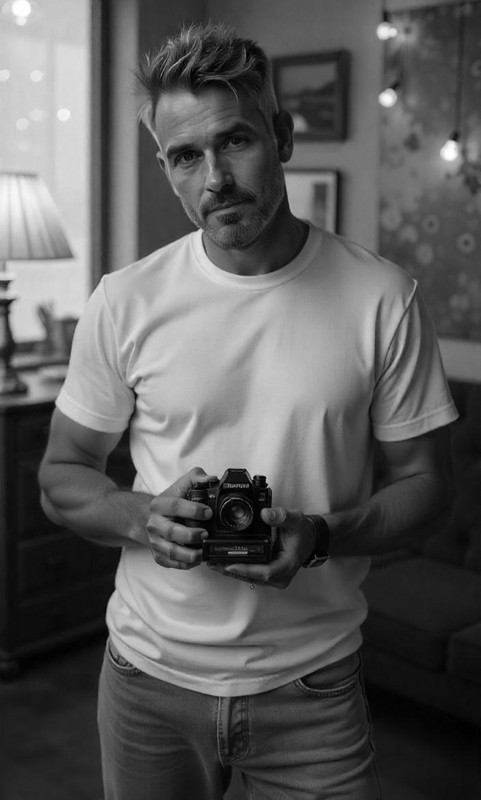
Rudy is already there. Camera on a chair. Not in his hands. That alone shifts something.
“You didn’t bring anyone,” Teddy says.
“You were told not to,” Rudy replies.
Rudy finally looks at him properly.
“Since I stopped pretending I’m only watching.”
That lands differently.
Not loud.
Clean.
—
There’s no crew to arrange him. No assistant to fix his collar. No voice telling him where to stand.
Just space.
And Rudy.
“Took you long enough,” Teddy says, dropping his bag near the wall.
Rudy steps forward.
For the first time, not to observe.
To position.
“Stand there,” he says.
“I know.”
A pause.
Teddy doesn’t move.
Not yet.
He studies Rudy instead.
“You always like this when no one’s looking?” he asks.
Rudy’s expression doesn’t shift.
“No.”
That honesty makes the room feel smaller.
Teddy exhales, almost amused.
Then he walks where he’s told.
The camera comes up. But Rudy doesn’t shoot immediately. He circles him once.
Slow.
Not predatory. Not casual. Intentional.
Teddy tracks him with his eyes, not moving his body.
“You’re different like this,” Teddy says.
“Like what?”
“Like you’re actually here.”
Rudy stops in front of him.
Close enough that the distance becomes a decision, not a default.
“I’ve always been here,” he says.
Click.
First shot.
“Don’t perform,” Rudy says.
“I’m not asking you to be empty,” Rudy adds.
Click.
“I’m asking you to stop pretending you’re not affected by anything.”
That one hits quieter.
Teddy’s expression shifts almost imperceptibly.
Rudy notices immediately.
Steps closer.
Click.
“There,” he says. Not loud. Not sharp. “Don’t fix it.”
“You are,” Rudy says.
Another click.
Silence stretches.
Not awkward.
Charged.
Teddy tilts his head slightly.
“So what now?” he asks.
Rudy lowers the camera just enough to speak without it between them.
“Now I direct you.”
A beat.
Teddy almost smiles.
“That what this is?”
“No,” Rudy says. “This is the first time I’ve stopped lying to myself about what I see.”
That’s new. Too direct. Too exposed.
Teddy doesn’t step back.
Instead, he exhales slowly.
“Alright,” he says. “Direct me.”
Rudy moves in again. Not touching. But close enough that Teddy feels it in his posture.
“Turn slightly,” he says.
Teddy does.
Click.
“Don’t smile.”
“I know.”
Click.
“Look past me.”
Teddy shifts his gaze.
Not at Rudy. Through him.
Something in his face changes without permission.
Not softness. Not hardness. Something unguarded.
Click.
Rudy stops. Just stops shooting.
That’s the first crack.
Teddy notices immediately.
“What?” he asks.
Rudy doesn’t answer right away. Camera still in hand, but lowered.
“You do that,” Rudy says quietly.
“What?”
“That thing where you disappear a little.”
Teddy’s smirk fades just slightly.
“That’s just lighting,” he says.
“No,” Rudy replies. “It’s not.”
A long pause. The dust in the air moves like it’s listening.
Teddy shifts his weight.
“You’re weird when you talk,” he says.
Rudy almost smiles. Not quite.
“I usually don’t.”
“Yeah,” Teddy says. “I noticed.”
Silence again.
Then Rudy lifts the camera. But doesn’t shoot.
Instead:
“Come closer,” he says.
That’s the shift.
Not command.
Invitation.
Teddy steps forward.
Now there’s almost no space between them. The camera hangs between their realities like a third presence.
Rudy’s voice lowers.
“Don’t give them what they expect,” he says.
“Everyone,” Rudy answers.
Click.
“You don’t have to become what they want to survive it.”
That one lands differently. Teddy doesn’t joke it away.
Doesn’t deflect.
Just stands there.
Still.
For the first time in a while, not performing even the idea of performance.
Rudy lowers the camera again. Looks at him. Not through glass. Not through framing. Directly.
“I think you’ve been alone in a room full of people for a long time,” he says.
Teddy exhales, quiet.
Something almost like a laugh. Almost not.
“Yeah,” he admits. “That sounds about right.”
Rudy doesn’t move closer. Doesn’t close the gap. Just holds it.
“I’m not going to fix that,” he says.
Teddy looks at him.
“I didn’t ask you to.”
A pause.
Then Rudy:
“Good.”
The camera clicks again. But this time, it doesn’t feel like capture. It feels like recognition that refuses to look away.
And Teddy, standing in that frame, realizes something he doesn’t say out loud:
This is the first time he hasn’t been turned into a version of himself.
He’s just… being seen.
No edits. No expectation. No escape route.
And somehow, that’s louder than any crowd he’s ever stood in front of.
***
Chapter Seven: Afterimage
The room feels different after Rudy leaves. Not emptier. Stranger than that. Like something was rearranged while Teddy wasn’t looking.
He stays for a while anyway. Sits on the edge of a chair that was never meant to be comfortable. The camera is gone. The instructions are gone. Even the idea of being “seen correctly” feels like it’s still echoing off the walls, refusing to settle.
Teddy exhales through his nose, half a laugh that doesn’t fully form.
“Well,” he mutters to no one. “That was new.”
But his body hasn’t caught up to his voice yet.
That’s the problem.
His body remembers.
He notices it first in the smallest way. The absence of performance. Not the absence of people. He’s used to that after shoots. The assistants leaving. The silence returning.
This is different.
It’s the absence of how he usually exists inside a room.
Like Rudy didn’t just photograph him. He adjusted the angle he stands at in the world.
Teddy rolls his shoulders, tries to shake it off.
Doesn’t work.
***
Outside, the city is loud in its usual way, but it doesn’t sync up with him anymore. People brush past him. No one looks twice.
That should feel normal.
It doesn’t. Because for the first time in a long time, he knows what it feels like when someone actually does look twice… and means it.
He doesn’t go back to the hotel right away. Ends up walking instead. No destination. Just motion.
His mind keeps replaying it in fragments:
“Don’t perform.”
“Stop pretending you’re not affected.”
“Come closer.”
“I think you’ve been alone in a room full of people for a long time.”
He scoffs under his breath once.
“Dramatic,” he says to the air.
But it doesn’t land like sarcasm usually does. It lands like recognition. That’s worse.
***
By the time he does get back, the noise has started again. Phones buzzing. Messages stacking. Invitations multiplying. People trying to reassemble him into something consumable.
Teddy ignores most of it. Then stops on one. A single file. No message. Just an attachment.
Of course.
He already knows who it’s from before he opens it.
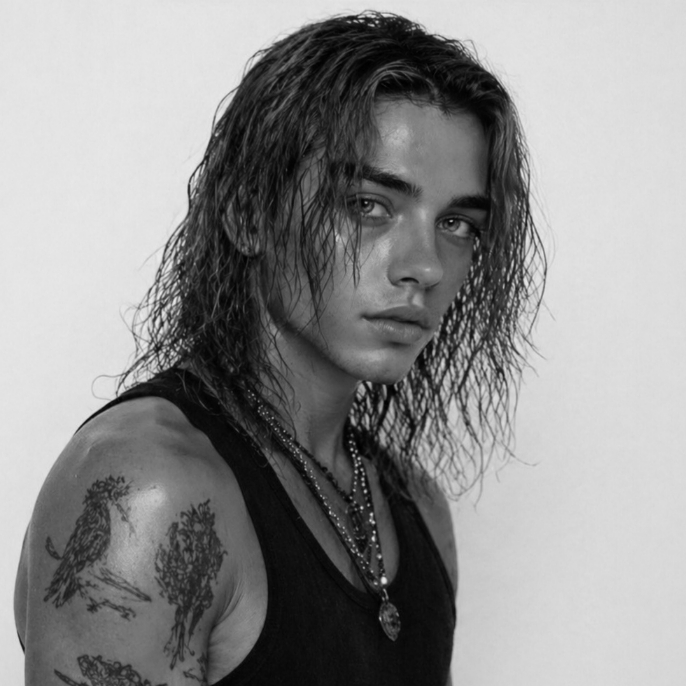
Black and white. Again. But this one is different. He’s not mid-performance. Not performing at all. Just standing. Still. Not guarded. Not open. Something in between that he doesn’t have a name for yet.
There’s no glamour in it.
No angle that flatters him.
Just him. Existing without permission.
Teddy stares. Longer than he means to. Then sets the phone down carefully, like it might shift something if he’s careless.
***
Later, he finds himself thinking about Rudy’s voice more than the images.
Not the camera.
Not the framing.
The instruction.
Don’t perform.
He tries to dismiss it. Can’t quite. Because the problem is—he didn’t feel exposed. He felt less constructed. And that is not the same thing.
Not even close.
***
The next time they meet isn’t planned. It never is with Rudy.
It’s in a corridor again. One of those liminal spaces between obligations. Rudy is there like he never left it. Camera slung low. Watching without watching.
Teddy slows before he reaches him.
“You always stand in hallways?” Teddy asks.
Rudy doesn’t look surprised to see him.
“I stand where people forget to perform.”
Teddy huffs a quiet laugh.
“Must be a lot of hallways.”
“More than you think,” Rudy says.
A pause. Teddy steps closer. Not casually this time. Not testing. Just… drawn.
“You shouldn’t have sent that,” he says.
Rudy tilts his head slightly.
“The photo?”
“Yeah.”
Silence.
Rudy studies him for a moment.
“I didn’t send it to show you something,” he says.
“Then why?”
“Because you asked me to stop lying to myself.”
That lands clean.
No drama. No softness added after the fact. Just truth, placed between them.
Teddy exhales. Looks away first, which is new enough to register.
“Didn’t think you’d actually listen,” he mutters.
“I don’t ignore things I see clearly,” Rudy says.
That makes Teddy glance back. There it is again. That edge. Not admiration. Not obsession.
Attention with no disguise.
“You’re going to make this weird,” Teddy says, but there’s no real bite in it.
Rudy almost smiles.
“It already is.”
That gets something out of him.
A real laugh this time.
Short. Sharp. Surprised. It breaks the tension just enough to make it breathe instead of snap.
When they part again, it’s not clean.
It never is now. Teddy walks away with something lodged under his ribs that he can’t identify yet.
Not comfort.
Not threat.
Something in between that keeps rearranging how he moves through space.
And behind him, Rudy doesn’t follow. Doesn’t need to. Because now Teddy already knows:
He’s being seen differently.
Even when no camera is there.
Especially when there isn’t.
Chapter Eight: The One Who Watches
Rudy doesn’t photograph people.
Not really.
He photographs the moment they stop knowing how they’re being seen.
That’s the rule.
It’s the only rule he’s ever kept.
Don’t direct. Don’t interfere. Don’t become part of the frame. If you stay outside it, you don’t distort it.
If you don’t distort it, you don’t lie.
Simple.
He learned that early.
Subjects change the second they feel shaped. They perform, adjust, correct. Even the ones who claim they don’t care, care enough to decide how they’ll be perceived.
Rudy doesn’t want decisions. He wants the slip. The fraction of a second where the mask doesn’t fall dramatically, just… loosens.
That’s where people are real.
That’s where he works.
Teddy Dove should have been easy.
That’s what Rudy thought at first.
Another almost-famous kid wrapped in noise and projection. A face that already belongs to too many people. Someone who would perform so constantly that eventually he’d trip over his own construction and give Rudy what he needed.
Predictable.
Trackable.
Contained.
He was wrong.
The first shoot unsettled him in a way he didn’t name. Not because Teddy performed. That part was expected. It was what happened underneath it.
The speed of it.
Most people layer themselves. You peel back one version, there’s another, and another, like staged rooms in a house built for visitors.
Teddy didn’t layer.
He shifted.
Too quickly.
Too cleanly.
Like he wasn’t building versions of himself. Like he was choosing them in real time.
That made him harder to read.
Which should have made him easier to photograph.
It didn’t.
Because every time Rudy thought he had him-there was a flicker. A drop. Something unguarded that didn’t look like weakness. It looked like absence. Like Teddy stepped out of himself for a second and forgot to come back right away.
And in that second-
Rudy couldn’t stay outside it.
That’s when the rule started to bend. Not break. Not yet.
Just… bend.
He told himself it was professional curiosity. That Teddy was an anomaly worth studying. That directing him once, just once, might reveal the structure underneath the shifting.
That’s all.
Just method.
It wasn’t.
The private shoot confirmed it. Rudy knew it the second he told him where to stand. The second Teddy didn’t move right away. Didn’t comply. Didn’t resist. Just… looked at him.
That look. It wasn’t defiance. It wasn’t submission. It was evaluation. Like Teddy was deciding whether Rudy had earned the right to alter the frame.
No one does that.
Not like that.
Rudy should have stepped back. Returned to observation. Let Teddy unfold on his own terms.
That’s how you get truth.
That’s the rule.
Instead, he stepped closer.
Spoke. Directed. Watched the shift happen in real time. And felt something he doesn’t usually allow: uncertainty.
Because Teddy didn’t collapse under direction. Didn’t harden. Didn’t reject it. He… responded.
Not to the instruction.
To the attention behind it.
That’s what broke the distance. Not interest. Not attraction.
Recognition.
Rudy knows what it looks like when someone is alone in a crowd. He’s built a career on it. He knows the posture. The micro-adjustments. The way people perform connection while standing slightly outside themselves.
Teddy doesn’t perform connection. He performs absence of need.
Which is worse.
Because it’s not true.
Rudy saw the crack early. That two-second drop in the first shoot. The one Teddy covered immediately. Most people would never notice it.
Rudy noticed. And more importantly-he wanted to see it again.
That’s the problem. Wanting changes the frame.
By the time he sent the photo, he already knew he’d crossed it. The line. The one that keeps him clean. Detached. Reliable.
He didn’t send it to provoke. Didn’t send it to impress. He sent it because Teddy had asked him to stop lying.
And for the first time in a long time, Rudy realized: he had been. Just a little. Just enough to stay outside everything.
Now he isn’t.
Standing in the corridor later, watching Teddy approach, Rudy registers the shift before a word is spoken. Teddy moves differently now. Not slower. Not softer. Just… aware of being seen in a way that doesn’t let him default to performance.
That’s new. That’s because of him.
Rudy doesn’t decide how he feels about that yet.
“You shouldn’t have sent that.”
Teddy’s honeyed-whiskey voice.
Measured.
Not accusing.
Rudy answers honestly. Because that’s the only option left now.
When Teddy laughs-really laughs-something in Rudy recalibrates again. Another variable. Another break from pattern.
This is what he understands, standing there: He didn’t break the rule because Teddy is interesting. He broke it because Teddy made observation feel incomplete. Like watching wasn’t enough to capture what was happening. Like distance was distorting the truth instead of preserving it.
And that’s dangerous. Not because of Teddy. Because of what it means for him.
Rudy has always believed: If you stay outside the frame, you remain unchanged. You document. You don’t become part of the story.
Now he isn’t sure that’s true. Because Teddy Dove is already adjusting around him.
And Rudy-whether he intends to or not-is starting to adjust back.
That’s the real break. Not the direction. Not the proximity. Not even the attention.
It’s this: For the first time, Rudy isn’t sure if he’s capturing something unfolding…or participating in it.

Loading comments...