


Book Description
Today’s gambling industry is a digital giant, buzzing with live games, mobile casinos, and Funky Time apps that put entire game shows at your fingertips. Yet, behind this dynamic digital front lies a story as old as civilization itself. Gambling is not a modern invention. It’s an instinctive part of human culture, deeply rooted in rituals, beliefs, and the quest for luck. From ancient dice found in Mesopotamia to betting rings in Roman arenas, gambling has evolved with humankind, reflecting the values and technologies of each era.
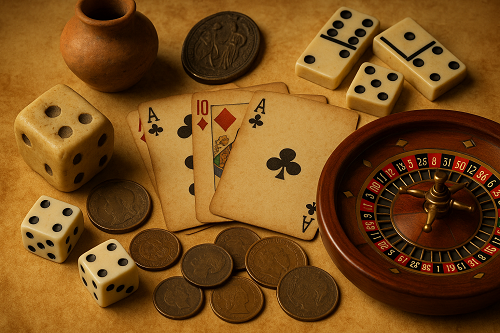
The First Dice: Games of Chance in Ancient Times
Archaeological discoveries show that games of chance were already popular over 5,000 years ago. The earliest dice, carved from animal bones, have been unearthed in the ruins of Mesopotamia and Ancient Egypt. These weren't just toys; they were tools for divination, used to predict outcomes and communicate with the divine. The Greeks and Romans later adopted dice games, transforming them into forms of entertainment and commerce. In Rome, soldiers were known to gamble between battles, wagering money, property, and even personal freedom.
Eastern Traditions: Gambling in China and India
Gambling traditions in Asia have a similarly long history. In Ancient China, rudimentary forms of keno and lottery-like games were played as early as 200 BCE. These early games were often government-sanctioned and used to fund public projects, foreshadowing today’s national lotteries. Meanwhile, in India, references to dice games and betting appear in the Mahabharata, one of the country's oldest epics. Gambling was both celebrated and condemned in these societies, seen as a test of fate and morality.
The Medieval Boom and Religious Clash
During the Middle Ages, gambling flourished across Europe. Card games, imported from the East via trade routes, became increasingly popular. However, the rise of Christianity and Islam brought new moral frameworks. Gambling was labeled a vice by many religious leaders, leading to cycles of prohibition and resurgence. Despite these restrictions, underground betting continued to thrive, especially during fairs, festivals, and tournaments.
From Taverns to Casinos: The Rise of Regulated Gambling
With the birth of modern states, governments began to recognize the economic potential of gambling. In 17th-century Italy, the Ridotto of Venice became one of the first legal casinos. Over the following centuries, more formal gambling houses emerged across Europe and the Americas. These were often located in elite settings—gilded halls, royal courts, and private clubs—where the wealthy could indulge in high-stakes games with decorum.
FunkyTime: A Modern Twist on Gambling Tradition
Fast forward to today, and gambling has moved online, becoming more accessible, interactive, and immersive. One prime example is the website FunkyTime, home to the hit game Funky Time developed by Evolution. Designed with HTML5 for seamless cross-platform play, this game embodies the future of online entertainment. Its colorful visuals, lively gameplay, and quick access via Funky Time apps for Android, iOS, Windows, and macOS make it a favorite, especially among users in Bangladesh.
But FunkyTime isn’t just about fun—it’s built for real engagement. Without a demo mode, players enter directly into the action, experiencing authentic thrills and strategic excitement. The app’s design supports real-money gameplay, stat tracking, and balance control, offering a modern gambling experience while tapping into age-old instincts: the desire to win, the thrill of uncertainty, and the joy of play.
Gambling has journeyed across millennia—from ancient bone dice to mobile gaming apps like FunkyTime. What started as ritual and recreation has become a global industry shaped by culture, technology, and human emotion. Whether you're rolling dice in ancient Persia or spinning the wheel on a high-tech platform, the essence of gambling remains the same: a timeless blend of chance, risk, and reward. As history shows, the urge to test fate is not just entertainment—it's a deep, enduring part of what makes us human.
